
CRUISES SECTOR
No plastic, less weight, less space - the perfect solution at sea.
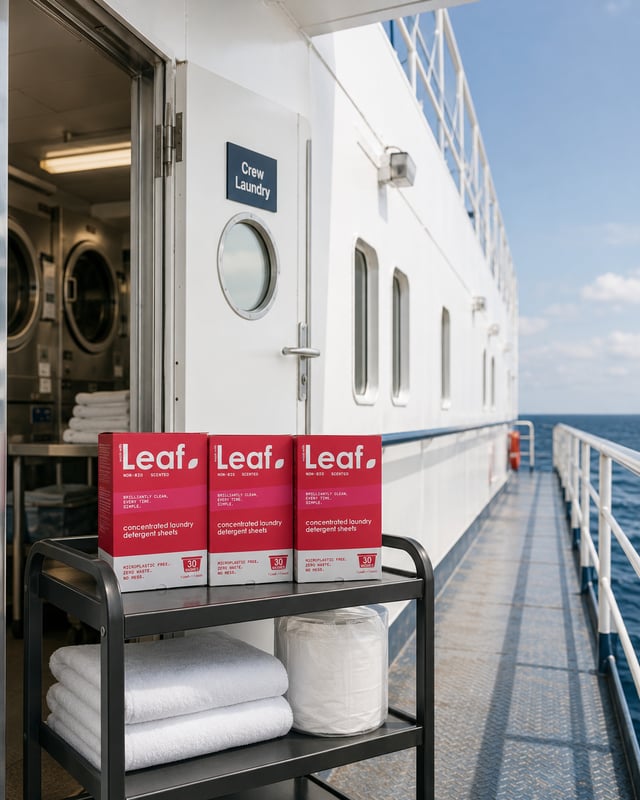
The operational problem
Bulky chemicals compete for space that ships don't have.
Liquids are mostly water — and at sea, water is the one thing you don't need to carry. Drums and bottles consume stores space, add weight, slow down provisioning at turnaround, and create handling work on every deck they travel through.
How Leaf simplifies the work
- →Compact sheets cut the stores footprint of cleaning and laundry chemicals.
- →Lighter provisioning speeds up loading at turnaround.
- →Pre-measured dosing holds one standard across a large, international crew.
- →Less packaging on board means less waste to manage at sea.
Evidence a buyer would need
- ·Dosing and storage specifications
- ·Stores footprint and weight saving
- ·Cost per wash comparison at fleet scale
- ·Compliance & safety data
Comparison stats
How does Leaf compare?
A 2,000-passenger ship using 40 trigger bottles a day takes on 11.8 tonnes of cleaning product a year, occupying 25 cubic metres of stores and generating 803kg of plastic waste that must be handled under MARPOL Annex V. The same cleaning as pre-measured sheets weighs 16kg and occupies 0.17 cubic metres.
Per ship, per year — 40 bottles a day
| Measure | 750ml ready-to-use | Leaf cleaning sheets |
|---|---|---|
| Stores volume |
25.0 m³
|
0.17 m³
144× less |
| Weight embarked |
11,753 kg
|
16 kg
730× lighter |
| Plastic waste generated |
803 kg
|
0 kg
none |
| Cost (ex VAT) |
£20,294
|
£2,291
89% cheaper |
Per ship, per year, for a 2,000-passenger vessel using 40 750ml trigger bottles a day — 14,600 bottles. Basis: Jantex Washroom Cleaner RTU 750ml, £1.39 ex VAT, Nisbets, September 2026. One Leaf sheet makes one 750ml trigger bottle. Bottle weight 55g empty, 805g filled. Pack dimensions and weights from Leaf trade specifications. All prices ex VAT. Volumes are stores footprint, not liquid capacity. Against 5L concentrate dosed at 40:1, Leaf costs more per dose — the saving there is weight, stores space, packaging and dosing accuracy.
Per 1,000 washes — crew and guest laundry
| Measure | 5L commercial liquid | Leaf laundry sheets |
|---|---|---|
| Weight handled and stored |
30.9 kg
|
4.4 kg
7× lighter |
| Storage volume |
35.6 litres
|
19.4 litres
1.8× less |
| Plastic packaging |
0.9 kg
|
0 kg
none |
Per 1,000 washes, one sheet per wash, against 5L commercial laundry liquid dosed at 30ml per wash. Basis: Leaf Laundry 75-sheet pack; Bio Productions Non-Bio 5L, The Cleaning Collective, September 2026.
Sector case study
See how a cruise operation compacted its cleaning supply with Leaf.
The case study covers the stores baseline, how the switch was provisioned across sailings, and the measured results — with source and basis for every figure.
Frequently asked questions
Why use detergent sheets on cruise ships?+
Because ships pay for space and weight twice — once to bunker it, once to carry it. Leaf sheets remove the water from cleaning products, so the same number of washes and cleans travels in a fraction of the volume and weight.
Can pre-measured dosing work with a multinational crew?+
Yes — it's one of the format's strengths. The dose is built into the sheet, so there's nothing to translate, measure or dilute. Results are consistent regardless of language or experience.
Do compact formats reduce onboard waste?+
Yes. Less packaging comes aboard, so less waste has to be stored, sorted and offloaded — a practical benefit anywhere waste handling is constrained.